ICB2026 eng
September 28, 2026
Identification of Socio-Demographic Specificities and Emerging Challenges of Roma Inclusion in Education During the COVID-19 Pandemic
September 28, 2026LEARNING THROUGH INTERDISCIPLINARY FIELD EDUCATION
Project name: Learning through Interdisciplinary Field Education
Acronym: LIFEdu
Project number: 2019-1-CZ01-KA203-061379
Total project budget: 116 019,00 EUR
Project start: 1 September 2019
Project end: 31 August 2022
Lead institution: Palacký University Olomouc
Partner institutions: University of Novi Sad, University of Maribor
Project members from the University of Novi Sad: Dr. Smiljana Đukičin Vučković (project leader), Dr. Jelena Milanković Jovanov (administrator), Dr. Anđelija Ivkov-Džigurski (member), Dr. Ljubica Ivanović Bibić (member)
Field education is an effective and innovative teaching practice at all levels of education. It can be applied both in the teaching of almost all independent subjects (or a broader field), and in the integrated concept of teaching. A suitable way of applying field education in school curricula, i.e. its further application in practical teaching, contributes to the efficient acquisition of a range of key and professional competencies. This can result in effects such as the student being better positioned in the labor market, acquiring the ability for complex thinking (in an interdisciplinary context), problem-solving, teamwork with personal responsibility, working with modern technologies, etc. For these reasons, the topic of interdisciplinary field education is the main idea of the entire strategic partnership, in which Palacký University Olomouc (as coordinator), the University of Maribor and the University of Novi Sad (as partner institutions) participate.
The main goal of the project is to make field education visible and to highlight its advantages when conducting practical teaching at all levels of education. The goal of the project is to make such innovative practices turn field education into an integral part of school curricula and, as such, to gain its rightful place in regular school teaching. All project activities and main results are planned with regard to the most efficient achievement of the main goal, using the potential of the research team and the involved institutions. Among the most important activities of the project are intensive study programs focused on both theoretical and practical aspects of interdisciplinary field education, as well as short-term training of pedagogical staff focused on field education, the development of interdisciplinary methodologies, i.e. teaching materials useful during field education, and international conferences aimed at disseminating the project results. One of the key results of the project is the proposal for the application of field education in the curricula of each level of education (in the case of higher education, in selected study programs that educate future primary and secondary school teachers), i.e. in teaching programs based on interdisciplinary international research and the experiences of individual members of the project team.
The primary target group supported by the project activities are students and pedagogues from the universities involved in the strategic partnership. Within the dissemination activities, the target group will be significantly expanded to include students and teachers from other universities, primary and secondary education teachers, as well as non-formal education teachers. The innovation, i.e. the great difference compared to the traditional approach to the implementation of the curriculum proposal, is contained in the project solution itself, where the first and second step will be the analysis of national and school curricula, i.e. the development of an international comparative analysis. Such an analysis will be the basis for creating practical proposals for a new or innovative integration of field education into school curricula at all levels of education with examples of specific educational field activities.
The second difference from the traditional approach is the active involvement of teachers and students of teaching areas in selected project activities, which will strengthen the bond between students and their teacher. Course participants will also try out field activities themselves and, in an authentic environment, become familiar with the potential and ways of removing barriers to such a conceived course, regardless of qualification or level of education. This will lead to a practical understanding of horizontal and vertical relationships in the teaching process. Due to the planned way of disseminating the practical results of the project, it is expected to influence a wide range of teaching staff and students.
Program activity – LTTA "Outdoor activities"
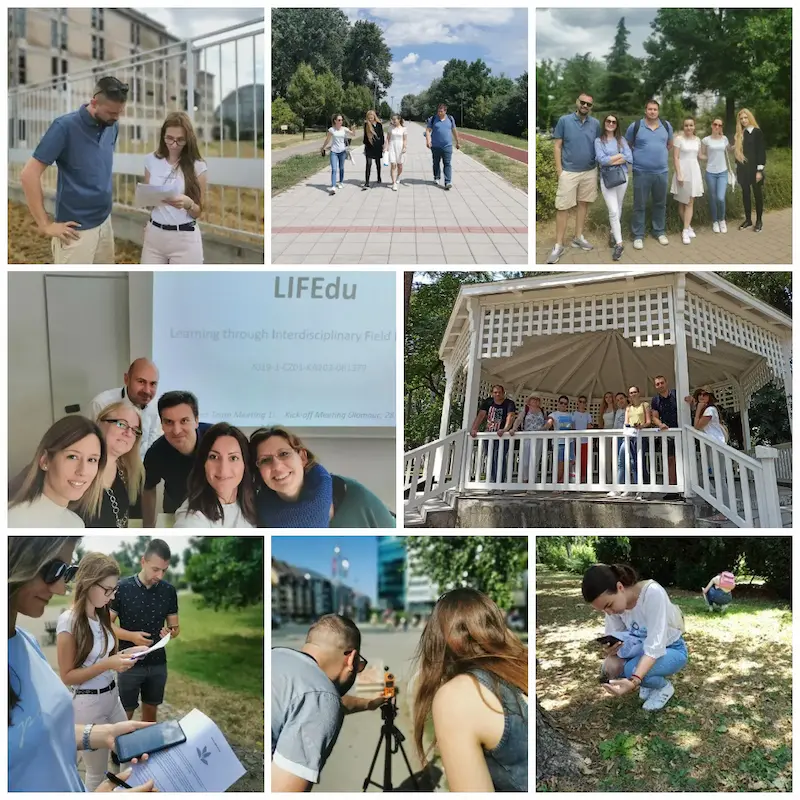
In the period from 26 June to 2 July 2021, a training was held in which, in addition to the team from Serbia, teams from Olomouc and Maribor also participated. The teams in all three countries consisted of university professors, students and primary and secondary school teachers.
During the intensive online training, the participants learned more about field teaching, the rules for conducting this teaching, and it was also presented to them how field teaching is conducted and what place it occupies in the curriculum of Serbia, the Czech Republic and Slovenia. During the training, the participants first in national and then in international teams designed activities that could be carried out within geography teaching, but also in the cooperation of geography with other subjects. The designed activities were later verified in the field within the national teams. The topics addressed by the activities are Quality of Life in Cities, Brownfield Locations, and Nature in Cities.
The training was successfully completed, and the results were presented on the last day.
In the last week of September 2021, a trip is planned for project team members, students, colleagues employed at DGTH and fellow teachers from schools to Maribor in order to continue work in international groups in the field in Slovenia, while the team from Serbia will host colleagues from the Czech Republic and Slovenia in Novi Sad in the spring of 2022.